



The Sisters of Book Row
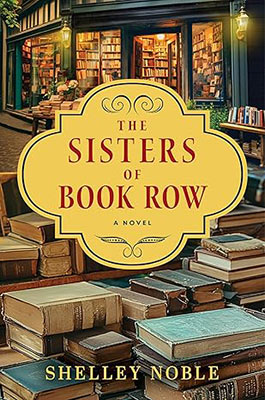
A thrilling and timely historical novel of books, banning, and the women who helped save New York’s famed Book Row, from bestselling author Shelley Noble.
1915: Manhattan’s Book Row, an eclectic jumble of forty bookshops along Fourth Avenue, is the mecca for rare book buyers from around the world, and the haunt of locals looking for a bargain. It is also the target of the most vicious censor in American history—Anthony Comstock.
And home to three sisters who vow to stop him.
For the three Applebaum sisters, the narrow, four-storied Arcadia Rare Bookshop is the only home they’ve ever known. Olivia, the oldest, is an expert in restoring rare manuscripts. Daphne, the outgoing middle sister, oversees the retail shop and is a favorite with their customers. Celia, the youngest, is left to dust and catalogue, but often sneaks out to do heaven knows what. Little do her sisters know, Celia has joined a group of young people who secretly print and distribute articles on women’s health by hiding them within the pages of ordinary cookbooks, household hints, and sewing patterns, despite the personal risk.
Meanwhile, the Comstock Laws threaten anybody who owns or circulates “obscene, lewd, or lascivious” publications. Even classic literature or fine art could send a person to jail. In the face of such oppression, Celia and the booksellers of Book Row band together. But secrets and a mysterious stranger mean the fate of the famed Book Row is anything but secure.
Cooper Union
Astor Place Manhattan
Summer 1915
“I’m going to be arrested. They’re probably on their way here now.” Margaret Sanger looked out over the group of serious young women. She smiled slightly, her canny, green eyes rested for a moment on Celia Applebaum in the front row. Celia smiled back as the panic rose in her throat.
Beside her, Selena Farmer shifted uncomfortably. Selena was married and had a new baby. She had even more to lose than many of the others. Celia nudged her with her elbow trying to signal that they would be fine, while she forced herself not to look toward the exit doors.
“I’m leaving for the continent immediately. I hope you will continue our work, but you must be careful. There will be reprisals. Anthony Comstock is a vicious man. And in my absence he will take all he can in his wake.”
“That’s why we must stop him!” yelled someone more courageous than Celia, who swallowed and clutched her papers tighter.
Margaret held up her hands. “Yes we must. His power is waning, but like all powerful men he will do anything to maintain it. He’s acting more and more reckless, making more outrageous claims. He is like a star blazing out of control, sucking up the air; it will burn the brightest before it dies. And it will die, leaving nothing but a grey pile of ash. But this is his most dangerous time. He will ignore rules and the law, even in his final hurrah. Remember. He will have his spies everywhere. Stay aware. Be brave. Stay safe. Now go. I won’t desert you for long .”
Celia watched her mentor leave the stage, petite, agile, her auburn hair flaming like a beacon to action. And then she was gone. Normally after meetings, the women would break into conversation as they gathered up their things, but today no one spoke. Just watched their leader walk out of the room and possibly out of their lives. Pamphlets were quickly slid into brief cases, hurriedly stuffed into grocery bags, tucked into waistbands or inside special pockets sewn into skirts for just such contraband.
Today, they walked in measured steps toward the exits, willing themselves not to hurry, to look normal. They separated at the door just as the Cooper Union students, mostly male , let out of class and hurried toward the street for a quick cup of coffee or a cigarette before the next began. Celia wondered if Margaret had planned it that way.
She clutched her knitting bag tightly under her arm and joined the other women as they were absorbed by the crowd. Heads down, anonymous, afraid that Comstock might already be out there watching, waiting for one of them to slip up. All of them wondering which one of them would not make it home tonight.
Arcadia Rare Books
Fourth Avenue
Book Row
Olivia Applebaum rolled up the shade from the front door of the Arcadia Rare Bookshop and peered outside. It was almost time to open and Celia was missing. Again. She would have to have a talk with her youngest sister about her continuous frolicking off to god knew where.
It was hard in the best of times to keep the shop profitable, they’d had to open the whole first floor to new as well as affordable used books. Had even joined the second hand booksellers in putting the cheapest volumes outside along the sidewalk. Their father would never have let that happen; Applebaum was a valued name in the world of distinctive antiquarian bookdealers. But Papa wasn’t around to disapprove or be disappointed, was he? He’d died three years ago, three years after their mother, taking with her his last chance of having a son to carry on his name and the business.
And yet their name was still on the sign above the door and the shop was still in business. His daughters had made sure of that.
Fortunately Olivia had taken to books at an early stage and had been sent to college to become adept at classical languages and continue improving her binding and restoration skills that she’d learned from him.
Luckily for her, she loved old books, spoke and read French, German and Italian well enough to translate. Could decipher several other languages. In the years since his death, Olivia had built a solid reputation and had pulled off some advantageous sales.
And yet they were still counting pennies .
She adjusted her eye glasses and a ripple of fatalism ran through her veins. It was now up to her to leave her sisters with a legacy. And she was running out of time.
Olivia pursed her lips and straightened a volume of Plutarch’s Lives on the glass display case.
“Now where is she?” Their middle sister Daphne brushed past her to peer out the bowed, display window. “It’s almost time to open.” Unlike Olivia and Celia who were dark-haired like their father, twenty year old Daphne had taken after their mother. She was light-haired and blue-eyed, with a vibrant complexion that even the dimness of the shop couldn’t dull. And, alas, more interested in charming the customers than selling books.
Today her work apron was haphazardly tied around a lilac calico dress more suited to an afternoon outing than a day in a musty book shop.
“I’m sure she’ll be back any minute. She left a note saying she was going for bread and bacon.” Olivia sighed, though it would already be too late to cook it for breakfast. Mr. Delereux had an appointment at nine to see the Rigg translation of The Decameron, a real find if she did say so herself. “But we can’t wait, I’ll help you with the outside carts.”
“It’s not fair,” Daphne complained. “She’s always running off and leaving me to do all the hard work.”
Olivia smiled sympathetically, though she was actually annoyed that her sister could look charming even when she was whining. Olivia had no such demeanor. Her sisters were always telling her not to look so grim. But Olivia was just born grim. By the time she was ten, her father had begun to tease her that she looked like a dowager. Of course, at ten, Olivia had already worn out the pages of Debrett’s, memorizing the most important members of the peerage—and she knew perfectly well what a dowager was.
Her fate was sealed.
Daphne scowled and rolled the first book-ladened cart across the wooden floor toward the door, dislodging their tabby cat, Jane, the only name all three sisters could agree on—but for very different reasons.
Olivia opened the door for her and together, they pushed the cart of used, worn, secondhand books over the saddle and onto the sidewalk, then maneuvered it up against the brick façade. Olivia took a minute to rearrange several books so as not to block the view of the more expensive items in the display window behind it.
Daphne paused as she passed Olivia on her way to collect the second bin. “You’ll have to say something to her. It’s the second time this week I’ve had to do her job. It isn’t fair.”
Olivia held the door while Daphne wrestled the second bin out the door and pushed it into place on the other side of the door, then she turned to stare down the street, hands on the hips of her brown tailored suit, searching the sidewalks for her wayward sister.
Daphne came up beside her. “How long does it take to get a loaf and a rasher of bacon? It’s already too late for breakfast.”
“We’ll have it for dinner,” Olivia said, distractedly. Where could the girl be? Olivia didn’t think she was up to trouble, though Lord knew she had been a handful even when their parents were alive. Into everything she could reach, curious about everything else. Active and intense, and always on the go, it was amazing that she did as well minding the store as she did.
Fortunately Celia was also fairly competent at cataloguing the items that passed through the shop, had an aptitude for figures, though no interest. And had been tasked with balancing the register at the end of each day. But, oh, Olivia could have used another committed, organized soul to take control of the daily operations of the shop while she concentrated on her restoration work and their more important clients.
She blinked against the sun that appeared suddenly over the rooftops. Then stood for a few moments just enjoying the view—while she still could. Already the doors across the avenue were beginning to blur. Colors to dim. The strongest spectacles in the world couldn’t stop her gradual loss of sight. Or take care of her sisters when she no longer could.
She took every chance to memorize the Avenue, burning it into her memory. The book shops, the printing shops, mixed higgledy-piggledy in with bakeries, shoe repairs and several delis and a luncheonette. Different colors, sizes, heights, constructed of brick, wood, and plaster. As different as they could be, some as fine as any uptown emporium, some barely more than a door and a narrow staircase to a second floor or down to an airless, dusky basement. But they all had one thing in common. A love of books.
To Olivia it was a magical kingdom, one she would lose soon enough.
She was glad that today at least, she could see that Mr. Wickes’s newsstand down the block had reopened for business. Poor man. Only last week, he’d been the victim of that man, Comstock, who raided him “on a tip.”
Not on a tip from any of the booksellers, Olivia was certain of that. Anthony Comstock was their sworn enemy.
Mr. Wickes was one of his innocent victims. He’d no more sell pornography than Olivia and her sisters. His newsstand sold newspapers, dime novels, magazines, and a variety of souvenirs. Comstock’s agents had confiscated a box of celluloid Statues of Liberty, mistaking them for the Venus de Milo who was considered pornographic by the self-proclaimed “morality man.”
Uneducated oafs.
Nonetheless, Mr. Wickes had to pay a steep fine to keep from being dragged off to jail by four Society For the Suppression of Vice agents.
More like thugs, if you asked Olivia.
The Row kept a fund for such occurrences. The Applebaums always contributed their share, though they had not been raided…yet. The booksellers on Book Row might squabble, undercut each other, or hold out on a rare find, but they wouldn’t stand by when one of their own was being mistreated. Especially by the self-appointed censors of Anthony Comstock. They always bailed out their colleagues and if necessary fed their families if they were brought to trial.
None of them were dealing in actual pornography of any kind. Someone like that would be drummed out of the neighborhood. All their good names were at stake.
Unfortunately Comstock couldn’t tell the difference between fine art, caricature, pornography and a doodlebug. Odious man.
But today all was normal on the Avenue. Awnings were unfurled. Outside shelves and bins were being replenished from the day before. Already the early shoppers were looking for a “steal” (sometimes literally) in the bargain bins, or hoping to spy a collector’s item from the throwaway boxes, left outside the shops each night, where people or other dealers left unwanted printed matter that others might be able to sell.
Next door at Teller’s Fine Printing and Stationary, Yannis Teller waved as he held the door for his mother, recently arrived from Lithuania as she carried a basket of hand painted greeting cards inside.
Across the street, Mr. Kirschenbaum stepped out of the narrow door of his art book shop and began sweeping the sidewalk. Olivia didn’t have to look at her lapel watch to know that it was five minutes to nine.
She glanced at her sister, still stewing because Celia had once again shirked her duties. In a way, Olivia envied their youngest sister. Not that she would ever admit it. “Come inside. She’ll be back, but we must open the store. You can take in the throwaway box and she can go through it later.”
“Fine.” With a huff Daphne hoisted the wooden box. “But I’m not touching these filthy old books. I’m wearing my good dress and it’s not my job!” She stomped over the threshold and staggered inside, trying to hold the cumbersome box at arms’ length.
Olivia followed her inside and closed the door, with a last glance out to the street, she turned the closed sign to open.
Cooper Union
Astor Place
Celia stood at the curb at Astor Place, just one among many, waiting for the trolley to pass by .
Was Margaret already speeding toward the ship that would take her to Europe? At least she would be safe there. Unlike the rest of them.
Celia would have to warn Yannis of the new circumstances as soon as she could take a break. Maybe at lunch.
She hadn’t even had breakfast. She’d sneaked out early on the pretense of going to the butchers for bacon. Now she was going to be late. Much later than a trip to the butcher’s would take. Be she couldn’t tell her sisters about the message she’d received last night about the emergency meeting this morning. She’d hardly slept from wondering what was happening.
Her stomach was queasy from hunger, lack of sleep and just plain fear. Reprisal. Margaret’s word rolled over and over in her mind. The Arcadia had never been raided. Book Row hadn’t always been the brunt of Comstock’s hatred, not while there were abortionists and prostitutes to chase down. But nothing was ever enough for him. And now he had a bunch of thugs making sporadic trips down to intimidate the little guys. Celia hated him.
Why was the trolley taking so long to take on passengers?
Across the street Bible House, by far the largest publishing and printing business on Book Row, filled the entire block. Comstock wouldn’t dare raid them. They mostly printed bibles.
The trolley finally started up and the sea of pedestrians rushed across the street.
Shifting her knitting bag more securely, Celia rushed with them. She didn’t knit, or sew or even cook all that well, but that was not what her knitting bag was for. The yarn inside was musty with age, covered with printers ink and grease spots. It was very useful, not for actual knitting, but for protecting eggs on the trip home from the grocer’s or for temporarily housing abandoned animals. Their own dear calico, Jane Addams, had briefly found sanctuary there when Celia had discovered her in the gutter half drowned and covered with ants.
Today it was secreting a pamphlet about the efficacy of using vitamins pre and post pregnancy. What was pornographic about vitamins? Even vegetables had vitamins.
But it was the two articles from Margaret’s magazine, “The Woman Rebel”, already seized by Comstock and destroyed, that had turned his attention to book Row. The original magazines hadn’t been printed there, but Celia was going to make sure the individual articles, already transferred to linotype castors ready to be printed, and now residing at the bottom of the old, green knitting bag would be. She wasn’t even sure what they were about. But she had absolute confidence they were needed.
As they reached the other side of the street, the subway station disgorged another crowd of people, most of whom, clerks, managers, cleaning staff and mannequins, hurried to work at Wanamaker’s. The department store had grown so large that it took up two full blocks on the west side of the Avenue. Celia could remember the days when her mother would take them to stand on the third floor skywalk that connected the two stores, where they could look down on all the people below. It was like standing in the sky. She never went there now, but Daphne still loved to “window shop” mooning over the latest fashions that she would never have any place to wear even if she could afford to buy them.
Wanamaker’s sold books, but they would never be raided. The idea was absurd. Comstock had set his sights on the belly of Book Row, the smaller shops between Tenth and Fourteenth streets; businesses that he could bully, who didn’t have the clout to fight back.
She picked up her pace as she passed the newsstand that took up most of the corner at Tenth Street. She could hardly see the top of its roof for the crowd pressed around it jostling to buy their papers and the latest news from Europe where a war had been declared and may of them had relatives still back home.
Celia reached Eleventh Street and was about to cross when someone called her name.
She whirled around, stuck between thoughts of war and fear for what she was carrying.
“Miss Celia, Don’t you want your bacon? It’s Monday. I saved you a nice meaty piece.” Mr. Krause, the butcher, was standing outside his door, his hand raised in greeting.
The bacon. Her excuse for coming out in the first place. She’d forgotten all about it.
“What luck, Mr. Krause. My head was in the clouds.”
He handed her a hefty slab wrapped in white paper and tied with brown string, just as he had done every Monday since Celia could remember.
“And how are you ladies getting on, these days?”
“Fine, fine—thank you.” She stepped away. She was really late and Daphne would not be happy if she had to open without Celia.
“And Miss Olivia, she doing well? Haven’t seen her in quite a while.”
“She’s been busy with the shop.”
“Well, you tell her I asked about her.”
“I will, thanks again.” Celia added the bacon to her knitting bag. Two doors later she nipped into the bakery where Mrs. Franchetti had saved a crusty country loaf.
“For my girls at the Arcadia.” She pinched Celia’s cheek as she did every visit. The loaf went into the knitting bag and Celia hurried on her way.
Everything seemed perfectly normal on Book Row, and Celia was beginning to think maybe she’d been overreacting about imminent raids and imprisonment.
Up ahead, Mr. Henderson was just going through his throwaway box. He added a volume to his outside shelves as she reached him. “Morning, Miss Celia. Only a few of these I can use. Shall I leave these others next door for Mr. Gepfert to peruse or would you like a look?”
“Thank you, Mr. Henderson,” Celia said, trying not to appear impatient, but she was going to be in such trouble if she was late again. “I’m sure our box will be full enough.”
“I’m sure it will. I swear this old Almanac has been around the block twice. I didn’t want it the first time round.” He tossed the book into a discard carton. “With any luck some urchin with sticky fingers will help himself. It should be worth a cent or two even with a torn cover and two years out of date.”
Celia nodded; she’d just seen Mr. Kirsch come out of his store and begin sweeping his sidewalk. Five minutes to nine, everyday even in the rain.
“I’m late,” she called back to Mr. Henderson. She cut crosswise across the avenue, past the back entrance of Grace Church without slowing down, and nearly bumped into two washerwomen who stopped to exchange some gossip on the sidewalk. She just managed to reach the Arcadia as Mr. Kirsch stepped inside his store.
Nine o’clock. The carts were already placed outside. She hurried into the shop.
Olivia and Daphne were waiting at the counter.
“Sorry,” she huffed. Olivia was looking taller and more severe than usual in her brown tweed suit. Her almost black hair was slicked back in a low bun, not a single strand out of place. She must have an important client appointment this morning. Celia unconsciously smoothed her own wayward tresses.
Daphne’s light curls perfectly framed her face, but her lilac flowered dress was covered by a work apron which meant she’d had to take out the book bins in Celia’s absence.
“Where have you been? What took you so long? I had to open the store and put out the street books and bring in the throwaway box and I’m dusty and moldy already and we haven’t even had breakfast. How am I supposed to meet customers this way?”
Assuming this last was rhetorical, Celia didn’t attempt to explain. The fact that Jane Addams had jumped down from her place next to a bust of Edgar Allen Poe, and was now threading figure eights around Celia’s ankles, should give her sister a clue.
She dug the bacon and bread out of her knitting bag and handed them to Daphne.
Jane Addams followed the bacon and rubbed up against Daphne’s ankles.
“Ugh. Jane Austen you naughty kitty, you’re leaving fur on my dress.”
“Then you better run upstairs so you can primp some more,” said Celia. “Take the bacon with you.”
Daphne stuck out her tongue.
“Don’t be such a brat. I said I was sorry.”
“You’re the brat.”
“Well, you —”
“Ladies, you’re both adults. Please act like it, customers will be entering any minute now, and they’ll find the two of you caterwauling like a couple of alley cats. And you’ve upset Jane Eyre.”
At the sound of her name, the calico pricked up her ears and gave her full attention to Olivia.
Olivia grabbed her skirt in both hands and lifted her hem. “No cat hairs, please. I’m expecting Mr. Delereux. He’s interested in The Decameron.”
“Really?” asked Celia. It would bring a handsome sum; money they could use. Running a book shop was a lot more expensive than even Olivia had anticipated and she’d been doing the books for their father for years.
“I’ll keep my fingers crossed. We both will.” Celia glared at Daphne.
“I hope he buys the whole shop,” complained Daphne, her full bottom lip slipping into a pout.
“Would you like me to cook the bacon?” Celia asked, sweetly, but thinking about a Sunday dinner of roast beef, potatoes and pudding if Mr. Delereux actually bought The Decameron.
“You’d just burn it.”
“Enough,” said Olivia. “We’ll have the bacon for dinner. Ah, here is Mr. Delereux now. You two may disappear.”
Daphne didn’t need a second order. She grabbed the book she’d been reading—probably a romance story, she was always reading about people in love—and took the stairs two at a time. Where she would stay upstairs for a good half hour cosseted with her mirror and curling iron.
The bell over the door tinkled.
Celia threw her bag into the throwaway box and shoved both to the floor behind the counter. Then threw herself after it. None of them were in any state to be viewed by their distinguished customer
She heard Olivia greet him in her most pleasant voice and they went upstairs to the private client parlour, for coffee and Turkish delight, one of Mr. Delereux’s favorites, followed by a change of venue to the rare books room and a hard sell from her upright and polite oldest sister.
As soon as Celia heard the old two person elevator clanking up the floors, she lugged the box back to the counter and quickly perused the contents. A book on the water plants of the Sicomac Valley. Two volumes of poetry by someone she’d never heard of. A dog-eared copy of a Bobbsey twins mystery. She set that aside for Daphne to consider. Two Boy Scout handbooks—they already had several in better condition. A math textbook and a stack of dime novels that had seen better days.
At the very bottom she found a cookbook that looked like it had fallen into the soup. A quick riffle through its pages revealed just what she’d hoped to find. A slip of paper used as a bookmark, which she quickly slipped into the pocket of her skirt.